1 History of Quantum Mechanics
In order to dive into the world of quantum properly, it pays to spend some time looking at its history. In this chapter, we will give a brief overview of how quantum mechanics came to be. This way, you will appreciate not only the beauty of quantum mechanics, but also understand why it is necessary to understanding the mechanics of our world. We will illustrate how the need for quantum mechanics became apparent by revisiting a few crucial experimental results that did not align with what classical theory would predict, thus demonstrating that more was needed to understand the world around us.
The content in this section is heavily inspired by Prof. Siddiqi’s notes for the introductory lecture in Physics 137A (Quantum Mechanics I) at UC Berkeley (see Siddiqi 2022).
1.1 Blackbody Radiation
To begin our story, we travel back to the mid-19th century. Around this time, Gustav Kirchhoff (yes, the one from your circuits classes1) was studying the physics of blackbodies:
Definition 1.1 (Blackbody) A blackbody (or black body) is an idealized object that absorbs all electromagnetic radiation (getting its name from how black absorbs all light).
Even though perfect blackbodies do not exist in the real world, this theory turns out to be a very good model for celestial bodies like planets and stars, which are precisely the objects Kirchhoff was studying.
Remark. This is a general theme in all of physics (and we will see it quite a lot in quantum mechanics); idealized toy models serve to help us understand more realistic phenomena.
Kirchhoff’s crucial insight was that a blackbody’s emissive power \(R\) was determined by only two factors: the emitted wavelength \(\lambda\), and its temperature \(T\). At around the same time, Josef Stefan empirically determined that the total radiation emitted by a blackbody is proportional to \(T^{4}\), meaning that the total power across all wavelengths, as a function of temperature, may be written as: \[ R(T) = \int_{0}^{\infty} R(\lambda, T) \ d\lambda = \sigma T^{4} \tag{1.1}\] The constant \(\sigma \approx 5.68 \times 10^{-8}\) is the Stefan-Boltzmann constant. While this relation was known, the functional form of \(R(\lambda, T)\) eluded physicists at the time. In the early 20th century, Lord Rayleigh and Sir James Jeans used a purely classical approach and arrived at a closed-form expression for this function:
Theorem 1.1 (Rayleigh-Jeans Law) \[ R(\lambda, T) = \frac{8 \pi k_B T}{\lambda^{4}} \] Here, \(R(\lambda,t)\) denotes the power emitted per unit area.
But, there is a problem with this formula! This formula predicts that, for sufficiently small \(\lambda\), objects should emit an enormous amount of energy, given the \(\lambda^{4}\) scaling in the denominator. Putting this into Equation 1.1 would result in infinite power across all wavelengths, since the integral diverges as \(\lambda \to 0\). Thus, while the Rayleigh-Jeans law accurately predicted experimental results for radiated power at high wavelengths, it failed to do so for lower wavelengths in the ultraviolet range and predicted infinite power across all wavelengths, which is certainly nonphysical; this discrepancy is what is known as the ultraviolet catastrophe2.
This is the first indication that classical physics was incomplete, because purely classical methods were not able to accurately explain certain phenomena and instead predicted infinite growth. How do we fix this?
1.2 The Quantization of Energy
The resolution, as it turns out, is to introduce the idea of quantization. To fully appreciate why this is needed, let’s take a small detour. First, consider a square box of length \(L\), and we want to calculate the number of standing modes in the cavity.
Definition 1.2 (Standing Mode) A mode is a standing wave state of excitation where all of the system’s components are affected sinusoidally at a fixed frequency. A wave is standing if it oscillates in time, but its peak amplitude does not move in space.
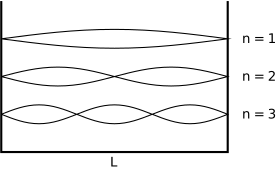
These waves must satisfy the wave equation:
Lemma 1.1 (Wave Equation) \[ \nabla^2 \psi(r, t) = \frac{1}{c^2} \pdv[2]{t} \psi(r, t) \]
The solutions to this differential equation are sine waves, which in three dimensions are functions of the form: \[
\psi(r, t) = A(t) \sin(k_x x) \sin (k_y y)\sin (k_z z)
\] Then, since we require that the wave only exists inside the cavity, we enforce the boundary condition that \(\psi = 0\) outside the cavity. We express this constraint mathematically by making the sine terms vanish at the walls of the cavity: \[
k_i = \frac{n_i \pi}{L}
\] Now, to solve for \(A(t)\), we plug this back into the wave equation, which gives us a solution of the form: \[
A(t) = A_0 \cos (\omega t) + \phi
\] The \(\phi\) factor is simply a phase which we don’t care that much about — we can always zero this out for simplicity3. What’s more important here is \(\omega\), which from our earlier condition on \(k\) satisfies the equation:
\[
\omega^2 = \frac{c^2 \pi^2}{L^2}\left( n_x^2 + n_y^2 + n_z^2 \right)
\tag{1.2}\] From this equation, you can then see that the number of ways \(n_x\), \(n_y\), and \(n_z\) can be chosen increases with increasing \(\omega\), which we now take some time to explore.
1.2.1 Number of Modes
Now that we have the full form for \(\psi(r, t)\), let’s actually figure out how many modes there are for a given \(\omega\). In other words, for a given wave energy \(\omega\), what is the number of allowed modes \(N(\omega)\) inside the box? To do this, we first define a density of states function:
Definition 1.3 (Density of States) The density of states, denoted \(g(\omega)\), describes the number of available states per unit volume per unit wave energy \(\omega\): \[ g(\omega) = \dv{N(\omega)}{\omega} \]
This way, we can represent the number of allowed modes with the following integral: \[
N(\omega) = \int_{0}^{\omega} g(\omega) \ d \omega
\] For a fixed \(\omega\), \(g(\omega)\) is implicitly given by Equation 1.2: it is equal to the number of ways to choose \(n_x, n_y, n_z\) such that the left and right maintain equality. Since \(N(\omega)\) integrates from 0 to the maximum allowed \(\omega\), then we are essentially looking for the number of ways to choose the \(n_i\) such that the right hand side of Equation 1.2 doesn’t exceed the left. Written explicitly as an inequality, we are basically looking for: \[
n_x^2 + n_y^2 + n_z^2 \leq \frac{\omega^2 L^2}{c^2 \pi^2}
\] This equation happens to be relatively easy to solve: the right hand side defines a sphere of radius \(\frac{\omega L}{c \pi}\), and since \(n_i\) must be positive, we must only consider the octant where each \(n_i > 0\), which is \(\frac{1}{8}\)-th of the volume of the sphere. As such, \(N(\omega)\) is given by: \[
N(\omega) = \frac{1}{8}\left( \frac{4}{3} \pi \frac{\omega^3 L^3}{c^3 \pi^3} \right) = \frac{\omega^3
V}{6 c^3\pi^2}
\] Here, \(V = L^3\) denotes the volume of the box. Converting this to linear frequency using \(\omega = 2\pi f\), we get: \[
N(f) = \frac{8 \pi^3 f^3 V}{6 c^3 \pi} \implies g(f) = \dv{N(f)}{f} = \frac{4\pi f^2V}{c^3}
\] Since each mode contains two different polarizations (you can loosely think of this as linearly and circularly polarized light)4, we have to multiply \(g(f)\) by 2 to get the full expression:
\[
\boxed{g(f) = \frac{8 \pi f^2}{c^3} V}
\] So far, this derivation is entirely classical, and it is motivated purely by the mathematics. As we will see, this is where the similarities in the classical and quantum treatment end.
1.2.2 Finding the Energy Density
When Rayleigh and Jeans derived their formula, they assumed that all modes exist and have energy \(k_BT\), a property given by the equipartition theorem.5 Under this assumption, the number of modes between \(f\) and \(f + d f\) is given by: \[ g(f) k_BT \ d f = \frac{8\pi}{c^3} f^2 V k_BT \ d f \] The energy density is given by dividing out the volume \(V\): \[ \rho(f) = \frac{8 \pi}{c^3} f^2 k_BT \ d f \] Changing this into an expression involving \(\lambda\) gives: \[ \rho(\lambda) = \frac{8\pi}{c^3} \frac{c^2}{\lambda^2} \frac{c}{\lambda^2} k_BT = \frac{8 \pi k_BT}{\lambda^{4}}. \] This is precisely the energy density given by Theorem 1.1, which we know fails. However, if we instead assume that not all modes exist but that energy is quantized, we get a different result.
Definition 1.4 (Quantization) When we say that a quantity is quantized, we mean that it comes in discrete packets (called quanta) and cannot gain/lose anything less than this discrete unit.
In particular, Max Planck suggested that energy may only be gained and lost in units of \(hf\), where \(h\) was dubbed Planck’s constant. With this assumption, it is possible to come up with a different energy density equation, now known as the Planck radiation formula:
Theorem 1.2 (Planck Radiation Formula) \[ \rho(\lambda, T) = \frac{8 \pi h c}{\lambda^{5}} \frac{1}{\exp(\frac{h c}{\lambda k_BT}) - 1} \]
The derivation for this equation is rather complicated, and involves the heavy use of statistical mechanics, so we will skip it here. What’s important is that this theory, unlike the Rayleigh-Jeans law, agrees very well with experimental data and no longer predicts unbounded growth.
So what’s the takeaway from all this? That we had to make a nonclassical leap in order to come up with the correct relation for \(\rho(\lambda, T)\) and explain a real-world phenomenon.
This is a first glimpse into why we need to study quantum mechanics; without it, our picture of the world would be incomplete! But what if something else had gone wrong? Did we really need this quantum leap to explain this phenomenon? If this example didn’t convince certain skeptical readers, let’s take a look at another paradigm-shifting experiment (namely, the one that earned Albert Einstein his Nobel Prize).
1.3 The Photoelectric Effect
Like the Planck radiation formula, the explanation of the photoelectric effect is also one that requires the assumption that energy is quantized.
Remark. Famously, it was Albert Einstein who proposed the correct mechanism for this phenomenon, and it was precisely this contribution that won him the Nobel prize, not his development of special/general relativity. Interestingly, Einstein was not happy about the inevitable probabilistic implications of this discovery, and he fought with prominent quantum theorists for years about whether quantum mechanics could ultimately be made into a deterministic theory (spoiler alert: it can’t).
The photoelectric effect can be described as follows: when you shine light onto a metal surface, the light transfers energy onto the electrons trapped inside the metal, eventually transferring enough energy to allow them to “escape” the metal, resulting in a phenomenon called photoemission.
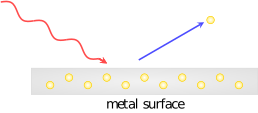
Naturally, if light were to gradually transfer energy to these electrons, one should expect that, even at low energy (e.g. microwaves or radio waves), the electrons would eventually accumulate enough energy to escape the metal, but in reality it does not — not all wavelengths of light generate photoemission, no matter the intensity and duration of exposure. By contrast, it seems that when the light reaches a certain frequency, photoemission does occur, even at low intensities and exposures. This frequency dependence is difficult to explain classically, under the assumption that any kind of light would transfer energy to the electrons.
So how do we explain this phenomenon? Einstein posited that, if light is quantized rather than a continuous beam of energy, this phenomenon can be explained. Specifically, we can imagine light as a stream of particles, each carrying an energy \(E = hf\) which it can impart to the electrons in the metal. He then theorized that there must be a minimum amount of energy required to remove an electron from the metal, called the work function \(\phi\). Since a photon can only deliver energy \(hf\) to the electron, this solves the frequency-dependent effect we couldn’t explain from earlier. This also explains why changing the intensity or duration doesn’t matter: the energy of the light quanta is only frequency-dependent, hence varying any other quantity has no bearing on photoemission.
1.4 The Double-Slit Experiment
The double-slit experiment is another famous phenomenon discovered in the early 19th century that challenged our classical view of light. The experiment is as follows: it involves taking a beam of light (usually a laser beam) shining upon a plate that has two parallel slits cut into them. Then, the light passing through the slits is captured on a screen behind the plate.
If light were to behave purely classically, we would expect to see two bright spots that trace out the shape of the slits on the screen. However, what is actually observed is an interference pattern: patches of light and dark spots spread across the screen that that gradually get fainter toward the edges. Now, if we are to assume that light is a beam of particles like we did with the Photoelectric Effect, this result makes no sense: only particles that fly through the slit make it onto the screen (and there is no force that allows them to spontaneously change momentum), so an interference pattern does not make sense.
However, this phenomenon can be explained if we take a different approach, and assume that light consists of waves instead of particles. This way, as waves travel through the slit, they experience a phenomenon known as diffraction, where light passing through the slits generate wavefronts that interfere with each other. This way, light going through one slit can interfere with the other, producing the interference pattern we see on the screen.
Remark. This is a version of the Huygens principle, discovered by Christiaan Huygens in 1678 and applied primarily to classical wave propagation, but it works here as well.
The double-slit phenomenon, combined with the Photoelectric Effect, showcase a concept in quantum physics called the wave-particle duality. Specifically, it refers to the fact that light behaves both as a wave and a particle, depending on the context. In the double-slit experiment, light behaves as a wave, whereas it behaves like a particle in the photoelectric effect.
It’s often misunderstood that light somehow “chooses” to either be a wave or a particle depending on the experiment. In reality, wave-particle duality is better understood as light simultaneously behaving as a wave and a particle – doing the experiment simply allows us to see one of these two expressions.
Even though waves are a fundamentally classical object, the fact that a certain object can exhibit either wave or particle behavior depending on the scenario is the crucial non-classical leap. A wave on water can never behave like a ball, and vice versa.
1.5 The Case of the Electron
As a last example to motivate the need for quantum mechanics, there was a known problem with the classical model of the atom. In the late 19th and early 20th century, the leading description of the atom was the Bohr model, which depicted an atom as a miniature planetary system. However, there was a problem with this model: by this point, it had already been established that moving charges radiate energy in the form of electromagnetic waves, which means we could in principle calculate how much energy an orbiting electron should radiate. As it turns out, if the electron really did orbit according to this model, then the amount of energy it dissipates would have sent it crashing into the nucleus within \(10^{-11}\) seconds!
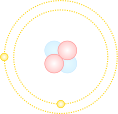
Clearly this isn’t true, so classical models once again fall short of accurately describing small systems. Fortunately, quantization resolves this as well: by introducing allowed energies that the electron can exist in and removing the idea that the electron orbits around the nucleus, the problem vanishes immediately.
1.6 Conclusion
These examples are not meant to suggest that classical mechanics is wholly inadequate; rather, they simply illustrate that there are certain instances where classical principles fail to accurately predict real-world phenomena. Things like the Photoelectric Effect, the Ultraviolet Catastrophe, and electron radiation cannot be explained without introducing the quantization of energy, and phenomena like the double-slit experiment challenge our intuition, forcing us to accept that there are particles that can be both a wave and a particle at the same time. While this doesn’t immediately motivate quantum behavior, it does illustrate that objects we once thought of as particles have wave-like properties as well.
Now that we’ve hopefully convinced you of the necessity of quantum mechanics, let’s now move on to develop some formal mathematics that will underpin the remainder of the theory.
If you haven’t taken a circuits class yet, don’t worry; you’ll do it eventually, so we might as well bring him up now.↩︎
This term was coined a bit later by Paul Ehrenfest, as the error in the Rayleigh-Jeans prediction becomes most pronounced when the wavelength enters the UV range.↩︎
We will often deal with unknown phase factors that can be suppressed; it’s not of much importance exactly how we can do this at the moment, but when it becomes relevant, we’ll address it properly.↩︎
We will not worry about what this means exactly, for now.↩︎
The equipartition theorem says that the average energy of any quadratic degree of freedom in a system is \(\frac{1}{2} k_BT\). In short, the reason why each mode contributes \(k_BT\) is because the Hamiltonian for harmonic oscillators have two quadratic degrees of freedom: one in position and another in momentum. Each contributes \(\frac{1}{2} k_BT\), so in total each mode contributes \(k_BT\). For a more detailed explanation, consult a statistical mechanics book.↩︎